
ICYMI: MURKOWSKI HIGHLIGHTS TRIBAL HOUSING NEEDS DURING HEARING TO EXAMINE NAHASDA MODERNIZATION ACT
U.S. Senator Lisa Murkowski (R-Alaska), Chairman of the Senate Committee on Indian Affairs held an oversight hearing titled, “Examining Housing Needs in Native Communities,” and a legislative hearing to receive testimony on S. 5354, the Native American Housing Assistance and Self-Determination Modernization Act of 2026 (NAHASDA Modernization Act).
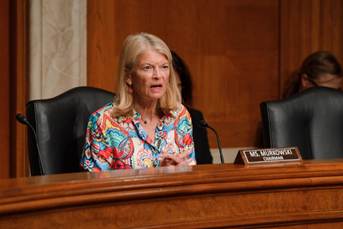
(Official U.S. Senate photo by John Shinkle)
Chairman Murkowski’s full opening statement can be watched here.
Witnesses included:
- THE HONORABLE BRYAN WARNER, Deputy Principal Chief, Cherokee Nation, Tahlequah, OK
- MS. HILARY ATKIN, Acting Deputy Assistant Secretary for Native American Programs, Office of Public and Indian Housing, U.S. Department of Housing and Urban Development, Washington, DC
- DR. ALICIA PUENTE CACKLEY, Director, Financial Markets and Community Investment, U.S. Government Accountability Office, Washington, DC
The bipartisan NAHASDA Modernization Act, S. 5354, reauthorizes and updates NAHASDA, the primary federal law governing housing assistance in Indian Country. Introduced by Chairman Murkowski and Vice Chair Schatz, S. 5354, is a revised version of the NAHASDA Modernization Act, S. 4276, which was introduced in the Senate in March 2026. The updated legislation reflects continued engagement with Native communities and housing organizations to modernize NAHASDA.
Addressing Middle-Income Tribal Housing Needs
During her opening statement, Chairman Murkowski raised Section 5 of the NAHASDA Modernization Act, a new provision that would allow Tribes, Tribally Designated Housing Entities, and the Department of Hawaiian Homelands to use up to 20 percent of their homeownership assistance to serve families earning up to 120 percent of Area Median Income (AMI).
“This matters because we hear from so many working families – whether they are teachers, health care workers, law enforcement officers, other essential workers – the problem is they may earn just a little too much to qualify under current limits but still cannot afford to buy a home in their community. So, it’s these folks that get caught in that awful situation,” said Chairman Murkowski.
Chairman Murkowski asked Dr. Cackley how the current 80 percent AMI limit affects Tribal members who may earn too much to qualify for homeownership assistance but still cannot afford housing. Dr. Cackley shared Tribes across the U.S. have reported that Indian Housing Block Grant funds (IHBG funds) limits leave middle-income Tribal members without sufficient housing support, including those returning from college or educational opportunities.
Chairman Murkowski asked Mr. Warner if Section 5 could address housing needs within Cherokee Nation. Mr. Warner unequivocally said it would, citing a Cherokee Nation housing study that estimates $1.75 billion is needed in housing investments and more than 6,000 households are on a waiting list.
“We have over 14,000 employees at the Cherokee Nation in our businesses, so we just wanna make sure that we give that leg up, that hand up to those households that have been through trials, been through tribulations, and have found their way to taking ahold of that opportunity, but then just finding themselves just a little bit outside those income guidelines,” said Warner.
This full exchange can be watched here.
Environmental Review and Streamlining
The 21st Century Road to Housing Act contains provisions that allow Tribes to assume greater responsibility for environmental reviews to reduce delays in housing development. Chairman Murkowski noted that Section 3 of the NAHASDA Modernization Act builds on this by allowing a single HUD environmental review for projects using multiple federal funding sources, expanding categorical exclusions for low-risk activities, and providing flexibility for radon and lead testing, floodplain management, and wetlands compliance.
The Chairman asked Ms. Atkin whether the provisions within the NAHASDA Modernization Act are still needed. Ms. Atkin confirmed that they are.
“The provisions in the reauthorization are still needed because they’re broader. They encompass more programs than the Road to Housing Act, than what is provided for Tribes and covers multifamily projects,” Atkin said.
“So, it sounds like these are not redundant – that this actually broadens and effectively it is allowing for a more efficient process… but it would also seem to me that you are strengthening Tribal self-determination and you still have appropriate environmental protections,” Chairman Murkowski said.
This full exchange can be watched here.
Continuum of Care Program
Chairman Murkowski asked Dr. Cackley whether the provisions in the bill have gone far enough to reduce barriers for Tribes seeking to access the Continuum of Care program.
Dr. Cackley said the provisions represent progress but noted that the program’s complexity and fair housing requirements remain barriers for Tribes. She also highlighted how doubling up and overcrowding are common in Indian Country but are not captured by HUD’s definition of homelessness.
Chairman Murkowski emphasized the real-world consequences of this gap, recalling a 2018 Senate Indian Affairs Committee Field Hearing she chaired in Savoonga, Alaska, where she saw a two-bedroom home housing 12 people. Family members slept in shifts throughout the day, underscoring that inadequate or overcrowded housing should be recognized as part of the broader struggle with homelessness.
“How we define homelessness actually matters, and it not only impacts whether or not you are in a place with a roof over your head, but to the point that you made, when you have too many people you’ve got safety issues,” said Chairman Murkowski. “You have issues that will have implications on a child’s education, if you cannot sleep given the conditions in your home.”
This full exchange can be watched here.
Tribal Homelessness
Chairman Murkowski highlighted that homelessness in Tribal communities looks different from homelessness elsewhere.
“In Alaska, Alaska natives make up about twenty percent of the population, but an estimated sixty to seventy percent of the homeless population in our state,” Chairman Murkowski said.
Chairman Murkowski noted that many Tribes want to use IHBG funds to address homelessness and asked Dr. Cackley and Chief Warner whether greater flexibility in how the funds are used could help support broader homelessness reforms.
“I think more flexibility is always a good thing because Tribes know what they need,” Dr. Cackley said.
“It’s absolutely paramount,” Warner said. “Resources are always going to be king but the other piece of that is flexibility – being able to utilize those dollars, make the moves that we need to make, because when you have a citizen that comes in and they tell you I’m homeless, but like you said they have a roof over their head they’re living with their aunt – they’re living with their grandmother. There’s three generations within that household – they’re still technically in my mind they’re still homeless.”
“Giving that flexibility, whether it’s moving that income median being able to utilize those dollars to do other things, that would definitely help us – especially in that homelessness area,” Warner concluded.
This full exchange can be watched here.
Video of the full opening statements delivered by the Chairman and Vice Chairman is available here.
Witness testimony and an archived video of the hearing are available on the Committee’s website.
The Committee will continue to accept written testimony until June 30, 2026. Testimony may be submitted to testimony@indian.senate.gov.
###
Legal Disclaimer:
EIN Presswire provides this news content "as is" without warranty of any kind. We do not accept any responsibility or liability for the accuracy, content, images, videos, licenses, completeness, legality, or reliability of the information contained in this article. If you have any complaints or copyright issues related to this article, kindly contact the author above.
